
How OEM and ODM Jewelry Costs Differ
The cost gap between OEM and ODM is not a single line item; it is a shift in who carries design work, tooling risk and minimum quantity. TTT Jewelry publishes no price list, but it does publish the variables that move a quotation: MOQs of 50 pieces in silver, 100 in brass and 100+ in stainless, a 25–30 day sampling window, and a plating menu of 14K, 18K, 24K gold and rhodium.

Key takeaways
- Design labour moves to the buyer in OEM and to the factory in ODM, but material MOQs stay the same in both.
- Silver at 50 pieces per design is half the brass minimum, so per-piece tooling share differs by a factor of two.
- Four published plating finishes change the coating stack, and each layer is a separate process step.
- Every extra sampling round adds 25–30 days, which is the most predictable cost of a late design change.
Where the money goes in a jewelry order
A jewelry quotation is built from metal, labour, tooling, plating, stones, packaging and inspection. OEM and ODM do not change the list; they change which items appear on the buyer's side of the ledger and which are bundled into the unit rate. In OEM the buyer typically supplies the design and the factory prices the route. In ODM the factory prices the design development as part of the programme.
That distinction is often blurred in negotiation. A buyer comparing an OEM quote with an ODM quote may be comparing a figure that excludes design hours with one that includes them. The lower number is not automatically the better offer; it may simply describe less work. In any OEM/ODM comparison, the first task is to establish which side of the ledger carries the development hours.
The second blur is tooling. A mould is a one-time cost attached to a design, not to a unit. Whether it is charged separately, absorbed, or amortised into the first order changes the apparent unit price without changing the total spend across the programme.
Tooling and quantity set the floor
Because a tool is fixed and units are variable, quantity decides how thin the tooling share can be spread. The table shows how the two service models touch that arithmetic.
| Driver | OEM | ODM | What moves it |
|---|---|---|---|
| Design labour | Buyer's cost, outside the quote | Inside the development fee | How complete the brief is |
| Tooling | Cut to buyer geometry | Developed with the concept | Whether the mould is reused |
| Quantity | 50 silver, 100 brass, 100+ stainless | Same thresholds | Number of designs, not units alone |
| Plating | Specified by buyer | Proposed and approved | Metal layers and finish type |
| Sampling | Buyer approves a known design | Buyer approves a new design | Number of revision rounds |
Read the quantity row carefully. The minimum applies per design, so a buyer opening ten designs at 50 pieces commits 500 units before a single reorder. A buyer opening two designs at 100 pieces commits 200. Design count is the multiplier that most often surprises a first-time buyer.
Reuse is the other lever. A mould that runs for three seasons spreads its cost across three orders. A mould used once carries the whole charge on one production run, which is why a one-off capsule collection looks expensive per unit next to a core line.
Plating is a cost lever with four published finishes
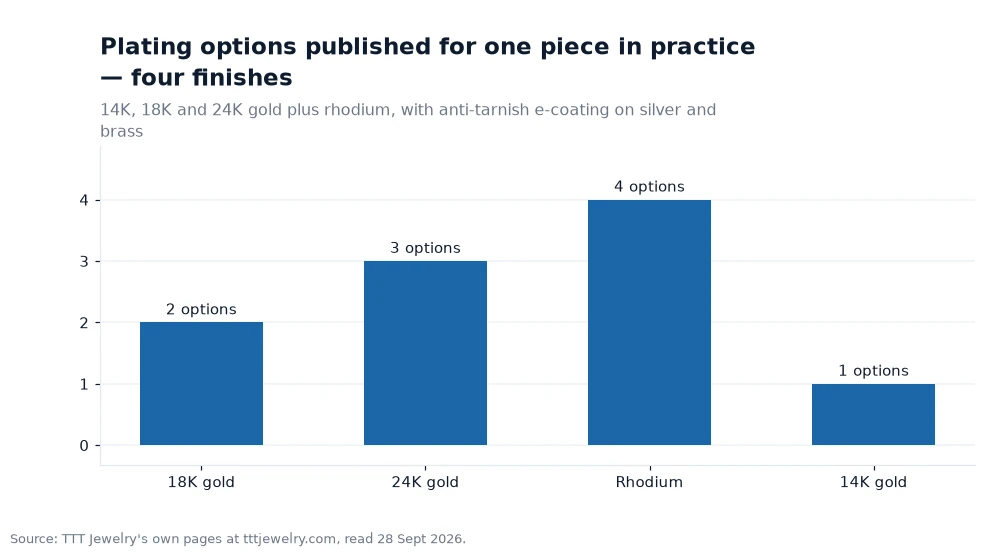
Plating is where specification and cost meet most directly. The published options are multi-layer 14K gold, 18K gold, 24K gold and rhodium, with anti-tarnish e-coating available on silver and brass, and PVD vacuum plating on stainless steel. Four finishes, four different process routes.
Each variant changes the number of passes through the tank, the preparation before plating and the inspection after it. A 24K gold finish reads warmer and softer than 18K; rhodium reads white and harder. Neither is inherently more durable in every context, but they are not interchangeable at the quotation stage.
Stainless steel follows a different path. PVD is a vacuum process rather than an electrolytic one, and the published claim is that 316L stainless with PVD is shower-safe and swim-proof. A buyer who specifies gold colour across silver, brass and stainless is therefore buying three processes, not one, and the quote should show that. The same logic governs bespoke jewelry OEM production, where the plating stack is written once and repeated across every run in the programme.
Compliance sits underneath all of it. Plating is stated as 100% compliant with REACH and CA Prop 65, which constrains the chemistry regardless of the colour chosen. ISO 9001:2015 is the process framework that keeps the plating record traceable from bath to batch.
Sampling rounds are the quiet cost
Sampling is usually treated as a calendar item. It is also a cost item, because a sample consumes bench time, a prototype and often a partial tool. The published window is 25–30 days per round, following CAD at under 48 hours.
Two rounds are common on a new design: one to see the shape, one to correct it. Each additional round adds 25–30 days and repeats the prototype work. On a programme with several designs, rounds can run in parallel, but a factory's sample bench has finite slots, so the tenth design does not necessarily start when the first one does.
The least expensive sampling round is the one avoided by a better brief. A drawing with stone sizes, wall thickness and finish per surface removes most of the reasons a first sample comes back wrong.
Worked example
Take a tooling charge of T and spread it over the published minimums. At 50 silver pieces, the per-piece tooling share is T/50. At 100 brass pieces, it is T/100. The ratio is (T/50) ÷ (T/100) = 2, so the silver buyer carries twice the tooling share per unit at the minimum order.
The same logic explains why doubling a run is worth negotiating before the mould is cut. At 100 silver pieces the share falls to T/100, half the 50-piece figure. The total tooling charge has not moved; only the denominator has.
Now add the calendar. One sampling round at 25–30 days plus 21–28 days of production plus 2 days of CAD gives 48–60 days. A second round makes it 73–90 days. If the programme is ten designs with one round each, the design count multiplies quantity, not time, provided samples are run in parallel.
Frequently asked questions
Why does a 50-piece silver order cost more per unit than a 100-piece brass order?
The fixed tooling charge is spread over fewer pieces, so at the published minimums the silver per-piece tooling share is twice the brass figure.
Is ODM more expensive because design is included?
The design work sits inside the ODM programme instead of on the buyer's side, so the quoted unit rate covers more, and the two models should be compared on total spend.
Does a thicker gold layer always raise the price?
More plating passes add process time and material, so a multi-layer 18K or 24K stack generally costs more to run than a single thin deposit, before any compliance testing.
Comparing quotes on structure, not headline
A useful comparison separates one-time costs from per-unit costs, then divides the one-time block by the planned quantity per design. That single calculation exposes most of the difference between two offers that look far apart at the headline.
Buyers who want the factory's own framing can read the factory direct manufacturing page, which sets out the six-step flow and the material minimums in one place. It is a shorter read than a quotation and usually clarifies which line items to ask about.
For repeat programmes, the custom jewelry wholesale structure is where tooling already exists and the per-unit arithmetic improves. The second order is where the first order's fixed costs stop repeating.
Source note: figures come from the manufacturer's own website (tttjewelry.com), read 28 Sept 2026.[1]